What’s all the fuss about high definition scanning?
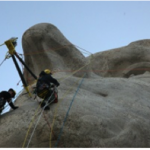
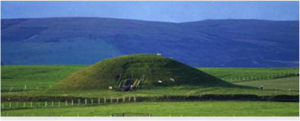
When it comes to making precise measurements in complicated environments, high definition scanning – or 3D laser surveying, as it is sometimes called – is quickly making its way to the front of the line in a wide range of industries from engineering to historic preservation.
Engineers use laser scans to work with real-world conditions in complex industrial as-built and plant environments. Construction companies use them to gather precise data on site terrain and renovations, and architects use them to check proposed design models against existing conditions to fine-tune their designs.
Even insurance companies and law enforcement have gotten on board, utilizing the technology to recreate large-scale accident scenes.
Why is it better? For one, laser scans are incredibly precise. Images are created from a “point cloud” of millions of points that can be measured precisely including the distances and elevations between points. They are also versatile. The scans, when used with digital color photos, can produce survey-quality files, videos or even 3D animated computer models and are so intuitive that even a novice can understand the information.
Laser scans are also fast. In 2006, when we bought our first scanner, it took almost an hour to produce a full dome 360 degree scan. Now we can scan in 6-8 minutes. This allows us to take many more scans and capture more detail than we did before.
Scanning almost always pays for itself. It is cheaper in the long run because you can revisit the original scan multiple times from your computer desktop without having to revisit the project site. Also, because the technology is so precise, the need for construction reworks and expensive retrofitting is minimized or removed alltogether.
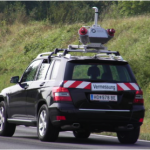
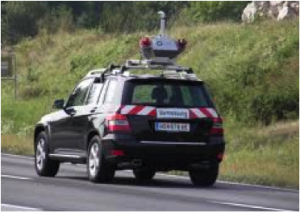
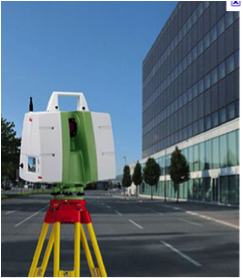
For firms thinking about getting involved with this technology, there are currently three ways to capture 3D data on large scale projects: Airborne LiDAR (Light Detection And Ranging), Mobile LiDAR, and Terrestrial Scanners, which all produce LiDAR data.
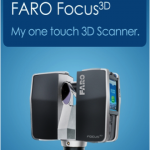
Typical projects for terrestrial scanners are large pipes and tunnels, manufacturing facilities, plant process facilities, airport conveyor systems, bridges, buildings, towers and construction projects. (Our firm focuses on terrestrial jobs, as most cannot be readily scanned from airplanes or cars.)
The cost of entry into this kind of scanning is generally between $150,000 to $250,000 for the first units and software. (Although less expensive scanners are now available, software packages can still be expensive and the cost of training should also be considered.)
Aerial platforms and Mobile Platforms start at $500,000 and go up to $5,000,000. These units are constantly being upgraded with newer and better digital sensors and data management enhancements. We currently work with service contractors on these types of jobs, which are typically focused on documenting civil infrastructure on a much larger scale than terrestrial scans.
Projects could include scanning 100 miles of road to prepare a pavement analysis, mapping 1,000 miles of rail line, or mapping the City of Atlanta and producing 3D models of all the buildings.
If the cost of these units seems intimidating, keep in mind that firms that have already invested in these technologies are often open to partnering opportunities with smaller firms.
Small scanning focuses on objects the size of a Volkswagen all the way down to the mechanical components inside of a watch. The applications in this field – commonly referred to as “reverse engineering” – include quality control of manufactured parts or data capture for a manufactured process. A typical project could be scanning an ornate stair rail so that an exact replica can be created from wood, metal or composite.
This scanning method is so precise that you could dissemble a toaster, rifle or carburetor, scan the parts, manufacture duplicates, and they would all work when re-assembled.
What can be scanned?
If it can be built, it can be scanned. There is virtually nothing built that cannot be duplicated and modeled with current scanning techniques.
In addition to the engineering, construction and manufacturing industries, this technology is also being used by insurance companies and law enforcement to reconstruct accident scenes – like when a highway bridge falls during rush-hour traffic or a multi-car pile-up – and even on Hollywood sets. There are companies that make their living scanning elaborate movie sets before and after they are constructed.
To give you an idea of the wide-ranging capabilities of this technology, in the last month, we have scanned a 120-foot pipe in Chicago, a 737 aircraft in Delaware, a luggage system in LaGuardia, and the interior of a peppermill in Virginia. This technology is everywhere!
###
Tate Jones has over 40 years of experience in land and aerial surveying and was one of the country’s earliest adopters of 3D laser scanning technology. A nationally recognized expert in the field of 3D data capture, he has worked with hundreds of clients in the engineering, architectural and construction industries. Contact him at tjones@3DLaserSurveys.com or visit www.3DLaserSurveys.com.
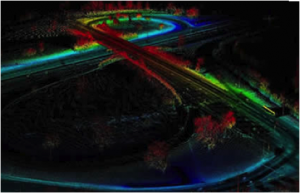
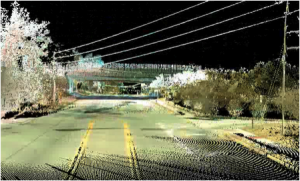
 In part 1 of my review of SPAR 2011 I referred to the new and fascinating innovations in software over the past year. I think probably the most important was the information from Autodesk that Revit 2012 will have a point cloud engine and many of the capabilities that other point cloud soft programs have and some new ones. Revit has become the standard for BIM for the private sector and the Architectural world, so this was a very important release. This will enable the Architectural community to be able to bring in and reference registered point clouds, and to benefit from the data-rich field that other software has been using. I have read many articles debating whether Architectural design firms wanted to be responsible for information contained within point clouds and there are good points on both sides of the room on this. However this new release will allow them to compare their design to actual conditions within the point cloud (clash detection) and just this ability alone will lead to construction savings and fewer design revisions. One of the new tools that was reviewed was their automatic feature extraction. This is the beginning of a road that will lead to many great advances in the point cloud technology. I saw this first in the mobile scanning programs. In that example you could fence in a sign type like a merge sign on an interstate on ramp and tell the software to go find it and it would retrieve 80 to 95% of the similar signs in the cloud. Inside the new Revit point cloud they are in the process of
 using similar technology to locate and capture elements that are already in the point cloud. This will lead to very big productivity gains. Just imagine if you could locate and detail all the windows in a building and have them sized and dimensioned automatically from just locating one and then having the software look for the remaining similar windows.
 ClearEdge3D has come through again. In the automated modeling world they were one of the first to come out with a software that detected flat surfaces for Architectural and structural modeling. They have again raised the bar with their new release of EdgeWise Plant. They have designed a plant and pipe software that can analyze a point cloud and automatically detect and model about 50% of the pipes in a minimal amount of time. Users were reporting that the time to model was approaching 1/3 the previous time on the same types of projects. There is still work to be done for total automation but remember 3 years ago there was not a point cloud to model automatic software! Now we are able to detect flat surfaces and pipe shapes. All will be improved as time goes on but what a great leap. I talk to some of my associates in the modeling business and they were looking at investing in the product. This was the first year some of them had considered making the step up.
 At the end of the second day, I and a few other associates I have seen over the years went to the booth for XYZ RGB. This stuff was so advanced that we had trouble understanding what made it work. The technology uses a set of two digital cameras and an additional random dot projector and software and can capture an image and turn it into a point cloud of very fine mesh. He could even photograph objects using Apple IPHONES. It is used in the movie, gaming and animation industries. It is excellent in small areas and does almost live animation of people. It can turn a photograph of a person into a model almost instantly. Very creative! I am sure it has uses that have not been tried yet.